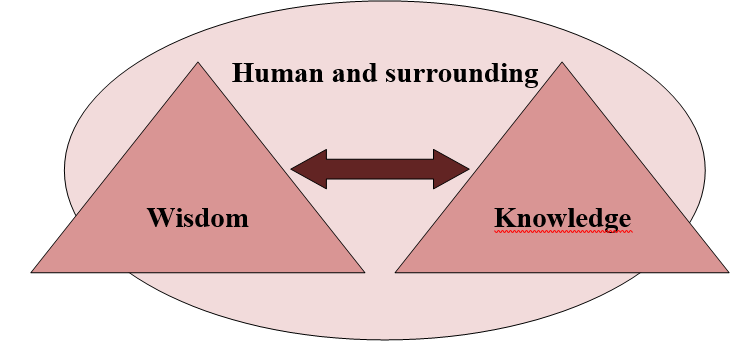
Philosophy is the most ancient area of knowledge. It originated simultaneously in India, China and Greece in the 6 century BC. Philosophy develops generalized system of knowledge about the world, in general, and the fundamental principles of existence. It also refers to the rational-theoretical level of outlook. Philosophical study must be distinguished from common sense. If a practical level can form spontaneously under the influence of tradition, custom, individual life experience of a human, rational-theoretical level is constituted deliberately. Mostly philosophy centered on a human, it seeks to know the attitude between human and world, to know the system of “world/human”.
The term “philosophy” comes from the Greek language. It consists of two words:
philos, (love, or philia – friendship, affection привязанность) and
sophos (learned scholar ученый муж , sage, or sophia - wisdom, knowledge, talent).
A brief etymological interpretation sounds like
“love of wisdom”.
Figure 1. Wisdom and Knowledge
There exists a question in philosophy about what is wisdom? What is this thing exactly that thinkers love? Some of philosophers of the past time have taken wisdom on the subject with great seriousness. But, the issue of wisdom has not received much treatment in the contemporary philosophical doctrines and literature.
The first thinker, who used the word “philosophy”, was Pythagoras . He did not dare to call himself as wise man, in his view: it is only God is wise, there’s only God’s wisdom. So, here is one of the first symbols of wisdom, philosophy – Iris (the rainbow as a bridge between earth people and sky gods). For the ancient Greek thinkers philosophy was not only a form of knowledge, learning, but also a form of life, existence. And even the first form or way of life.
On the theme of the essence of philosophy we have some complicated questions like: How can or should begin philosophy in each case? And how a single person attached to it?
Various thinkers have different answers to this question. Plato began to widely use the term “ philosophy” in his “Dialogues”. Then, Aristotle believed that philosophy begins with wonder . Wonder in front of the mystery of the world, its unity and diversity, its infinity. It is very difficult to be surprised and to see something in its untouched pristine. Interpretation of wisdom by Democritus rightly points out that philosophy cannot be reduced only to knowledge. For this, as pointed out before by another ancient Greek philosopher – Heraclitus , “knowledge of much doesn’t teach to be wise”. Descartes saw the real beginning of philosophy in doubt.
Philosophical knowledge is knowledge of a hole , integrity of the hole. “The world as a whole” – that could be defined as the subject of philosophy. The hole combines, integrates parts, and provides them into unity. It is clear that only something in common and significant can ensure unity of the objects. However, it should not be taken so that philosophy does not show any interest in the parts. Of course, a hole doesn’t exist without parts. But the parts are taken here in that connection that leads to a whole; include them in the general chain of the global process, in the fundamental unity of the world.
It is also important to have in mind that philosophy is internally dissected formation consisting of independent philosophic studies :
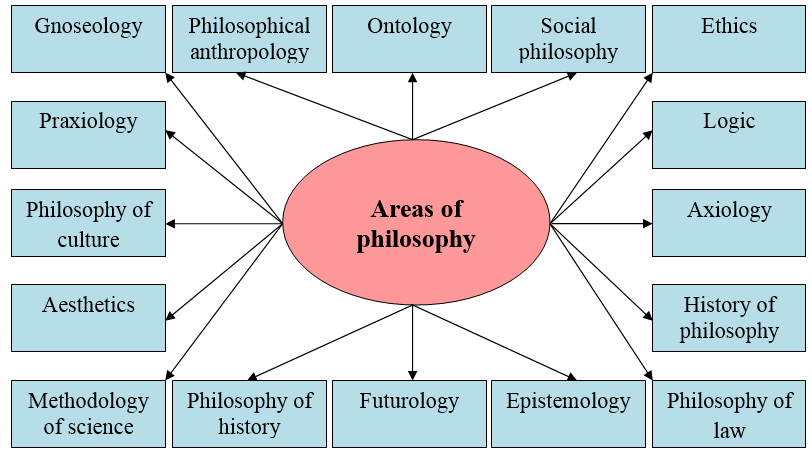
Figure 2. Areas of philosophy
We can mark that only ontology goes directly to “the world as a hole”. But, this does not mean that there no study of the whole, integrity in other philosophical disciplines.
Social philosophy studies the direction of the historical process (what is the history?), paradigms, i.e., model-patterns of social life of people. In all its forms philosophy teaches “ the holistic thinking” , an integrated interpretation of all existing parties, all aspects of human existence.
Philosophical knowledge, then, should be classified as problematic one. The problem enters philosophy exdefinitio (by definition).
In a rigorous, logical-philosophical approach the problem reveals its true meaning – to be an issue on which there is no answer in the existing system of knowledge, but which, nevertheless, growing out from it.
The problem is a kind of knowledge about ignorance, the bridge from the known world into the unknown world. In this context we can understand the Socratic phrase :
“I know that I know nothing”
In fact, expanding the circle of knowledge, we increase the area of contact with the world of ignorance, or the unknown. There are some problems in any science, but in philosophy those problems have eternal nature. That is philosophy deals with the problems, which don’t have any final decision, solution.
Each era and every great thinker give their own interpretation, understanding and resolution of philosophical problems – more or less authentic, compelling, but a very relative. Philosophical knowledge is not only problematic, but alternative. Philosophy makes a lot of different responses on any fundamental question . There is no final answer, but there are a lot of answers.
Philosophical knowledge is also critical knowledge . Philosophy checks all the dogmas, teachings, authority, all the values that have circulated in society.
Philosophical criticism reveals limitations and the relativity of all knowledge.
In this respect, philosophy is different than rhetoric which convinces (убедить) the listener in one way of the truth. The main instrument of philosophy is not conviction, and the discovery and critical test the truth.
Criticism is naturally connected with reflection. Reflection is self-conscious or cognitive thinking, self-aware knowledge search. Reflective thought is a thought, turned on itself.
Philosophical knowledge can be described as well as humanistic knowledge. In this case, we investigate person as a philosophical phenomenon because he exists in this world.
Philosophy interests in universality in its human, humanistic dimension and meaning. Philosophy explores the world, displayed on the person. Knowledge becomes philosophical knowledge when it is projected on the human being and is involved in the formation of his worldview.
Philosophy and science
Solution of the issue “is philosophy science?” depends on how we evaluate and explain science and how we understand philosophy. Science is usually identified with a system of methodological ideals, true knowledge, but it is an exaggeration and fallacy in some cases.
Firstly, the basis of any science has highly uncertain, indefinite character.
Secondly, at the highest level of science there exists its variety of key elements, its heterogeneity: unproven theorems, contradictory theories, purely hypothetical constructs, antinomies and paradoxes.
Thirdly, science comes as a social institution, that is, social diversity which contains people, their social roles, prejudices, misconceptions and rumors.
Philosophy contains more comprehensive essence, looking for generalizing the truth. Philosophy unites not only scientific, but religious, ethical, aesthetic theories and opinions.
Historical types of outlook: mythology, religion, philosophy
World outlook is a system of views on the reality and human’s place in it in a certain historic-cultural epoch. Outlook has a definite structure: everyday and scientific knowledge, creeds, faith, principles etc. Outlook carries out the function of human’s knowledge about both inner and outer worlds.
Outlook has two levels:
There are three historical types of outlook :
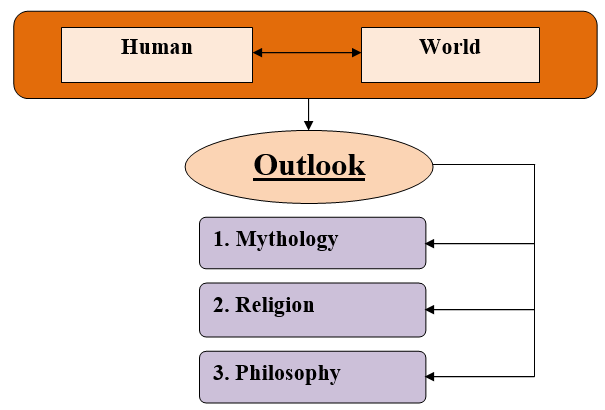
Figure 3. Historical types of outlook
Myth is the first form of cultural activity of man.

Figure 4. Types of myth.
Religion
is a faith in the supernatural force(-s), which is based on a strong system of moral norms and the special organization of people.
Faith
is a form of existence of religion. In the frames philosophy religion is the philosophical investigation of some key themes and notions involved in religious customs and traditions. The main feature of religion is faith, but it doesn’t mean that religion is the relationship between man and God, as it determines generally by theologians. Religion is not only a specific form of social consciousness, but also realizes the functions as a regulator of public behavior. The origin of religion relates to the level of development of the human intellect, when the beginning of theoretical thinking and clear thoughts come off from reality.
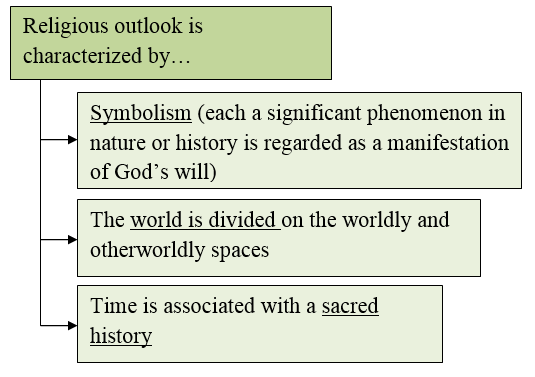
Figure 5. Elements of religion.
Definition of philosophy.
So, as much it’s defined before:
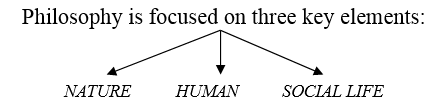
«Philosophy is the study of fundamental laws of the world, man and man’s place in this world»
The question of relation between matter and consciousness is one of the main questions in philosophy
This question has two aspects:
Functions of philosophy
Four basic functions of philosophy:
In general, philosophy course consists of…
and
History of philosophy contains chronological periodization that express specific approaches to philosophical problems and certain wais of their solutions.
Periods of evolution of philosophy:
Key findings:
Appointment of philosophy is an understanding the world and human security of the universal conditions of improvement.